If you're reading this, you've probably found a box, a drawer, or a safe-deposit case of jewelry that belonged to someone you love, and you're not sure what to do with it — or even what it is. That's a completely normal place to be. Most people have never had to think about jewelry this way before, and there is no expertise you're supposed to already have.
This question comes up constantly during estate settlement, and it rarely has a simple answer, because "worth" actually means a few different things depending on why you're asking. Sorting those out first tends to make everything else easier.
Nothing here requires you to do anything right away. Take whatever time you need — this guide will still be here.
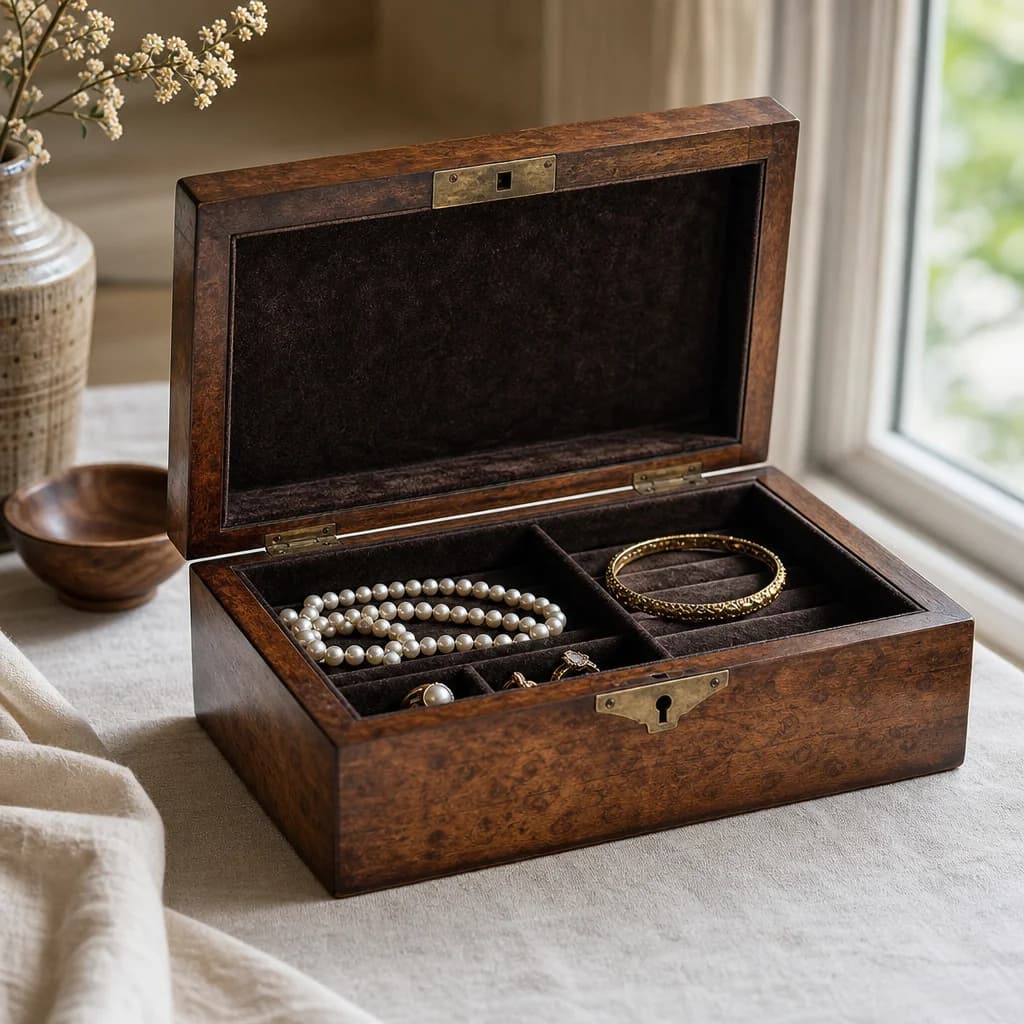
The three kinds of worth
When someone asks what a piece of inherited jewelry is worth, they are usually really asking one of three different questions. Knowing which one you mean makes the rest of this much clearer.
Sentimental value
This is the value only your family can measure. It has nothing to do with price, and no appraisal or offer can capture it. It is worth naming, and worth taking your time with, separately from any decision about selling.
Insurance (replacement) value
This is what it would cost to have a similar piece newly made and sold at full retail price today. It is the highest of the three numbers, and it is the one most people have seen before — often on an old appraisal document. It is not what a piece would sell for.
Actual resale value
This is what a buyer in the current secondary market — a dealer, a jeweler, a collector — would realistically pay for the piece today. It depends on the metal, the stones, the maker, the condition, and current demand. This is the number that matters if you are deciding whether to sell.
What actually drives value
A handful of factors shape what a piece is really worth on the resale market. None of them require special training to understand — just a closer look than most of us give jewelry day to day.
Metal and karat
Gold is marked by karat — 10k, 14k, 18k — which tells you how pure it is. Platinum is a separate, denser metal that is usually worth more by weight. A tiny stamp inside a ring or on a clasp usually tells you which one you have.
Gemstone type and quality
A diamond's size is only one part of its value. Its color, clarity, and cut matter just as much, and colored gemstones (sapphire, emerald, ruby) are judged on an entirely different scale. Two stones that look similar to the eye can be worth very different amounts.
Maker or brand signature
A tiny engraved name — Cartier, Tiffany & Co., Van Cleef & Arpels, or a respected watchmaker — can matter more to value than the raw materials themselves. These marks are often small and easy to miss.
Age or period
Jewelry made decades or a century ago is sometimes crafted in styles and with cutting techniques no longer common today, which collectors specifically seek out. Older does not always mean more valuable, but it is always worth a second look before assuming otherwise.
Condition
Loose stones, worn prongs, missing clasps, or old repairs affect value, but not always as much as people expect. In many cases a piece is worth more left as it is than restored — repair costs can exceed what they add back.
Certification status
A grading report from a lab such as GIA, if one exists for a stone, gives a buyer confidence in its specifications. Its absence does not mean a piece lacks value — it just means that step happens as part of the evaluation instead.
How much each factor moves the number
Two similar-looking pieces can carry very different numbers. Here is what a buyer examines for each factor, and how much that factor tends to move the result.
| Value factor | What is looked at | Impact on offer |
|---|---|---|
| Center stone quality | Carat, cut, color, clarity, and how the stone actually faces up in person | High |
| Certification | GIA and comparable reports reduce buyer risk and widen the resale audience | High |
| Brand or signature | Rolex, Patek Philippe, Cartier, Tiffany and other signed work trade above generic equivalents | High |
| Period and craftsmanship | Art Deco, Victorian, mid-century and hand-made mountings carry collector demand | Moderate to high |
| Condition and completeness | Original box, papers, service history, and whether restoration is needed | Moderate |
| Metal weight and purity | Gold and platinum content sets the floor, never the ceiling, on an estate piece | Baseline |
| Current market demand | Live wholesale demand across a jeweler, dealer, and collector network | Varies weekly |
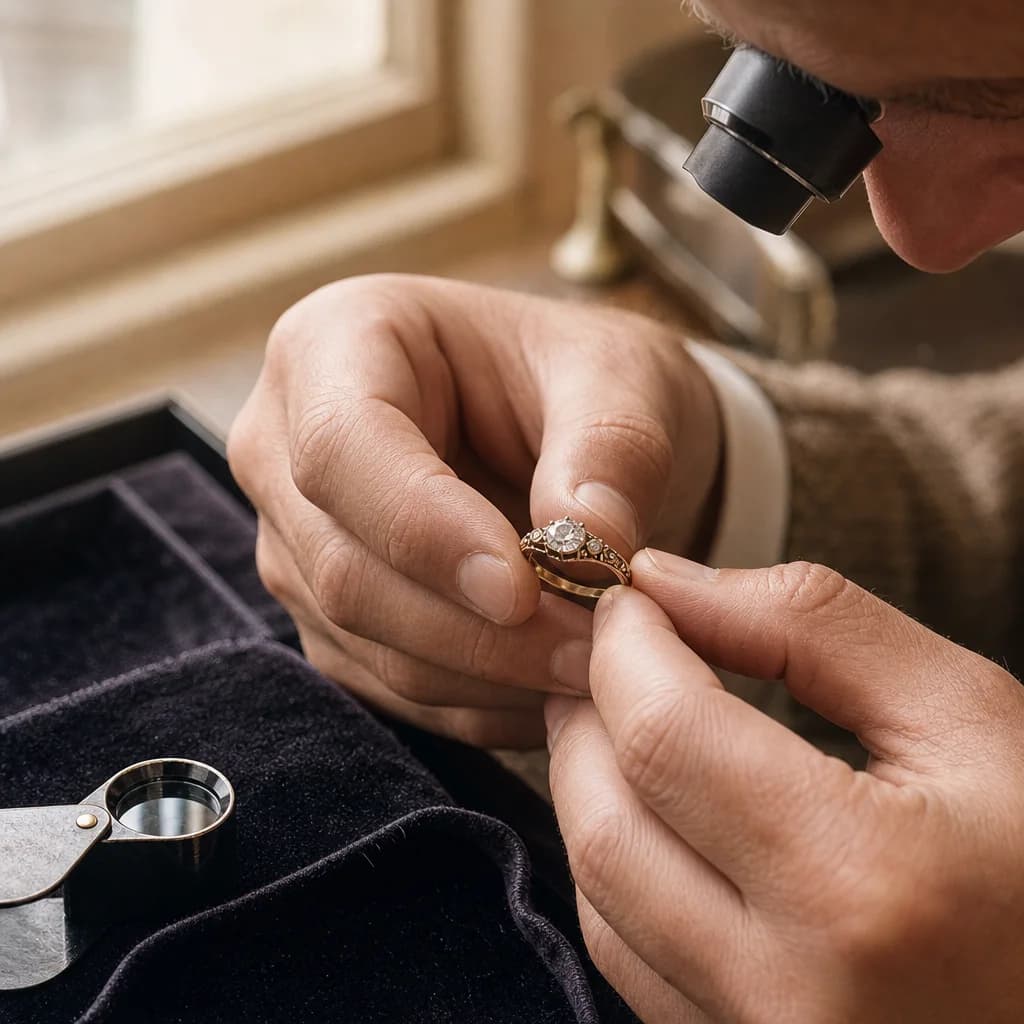
What families commonly find in an inherited collection
Certain categories come up again and again in inherited collections, and each one has its own quirks worth knowing about before you draw any conclusions by eye or by weight alone.
Signed or branded pieces
Jewelry from Cartier, Tiffany & Co., Van Cleef & Arpels, and similar houses is often worth well beyond its metal and stone content because of the maker itself. These signatures are sometimes tiny and tucked inside a band or under a clasp, so an unmarked-looking piece is worth a closer look before any conclusion is drawn.
Tennis bracelets and diamond jewelry
A line of small diamonds looks straightforward, but the combined value of many well-matched stones can be significant, and setting quality affects the total. There is no shortcut formula for this that works by eye alone.
Antique or period pieces
Victorian, Art Deco, and mid-century pieces often use cutting styles — like Old European or Old Mine cut diamonds — that read differently to a specialist than to a general buyer. Their age and style can add value rather than date it.
Pearls
Natural and cultured pearls are graded on luster, shape, surface quality, and size, not weight. A strand that looks plain can still be genuinely fine quality, and this is one of the harder categories to judge without experience.
Colored gemstones
Sapphires, emeralds, and rubies are valued on color saturation and origin as much as size. Some untreated or historically significant stones carry premiums that are not obvious from appearance alone.
Mistakes to avoid
None of these are unusual to consider — they're just worth pausing on before they become irreversible.
Taking the first cash offer without a second opinion
A quick offer from the first place you visit may be entirely fair, or it may reflect only the metal weight and nothing else. A second, unhurried look rarely costs you anything and often changes the picture.
Assuming no diamond means no value
Gold content, maker signatures, period craftsmanship, and colored gemstones can all carry meaningful value on their own. A piece without a center diamond is not automatically a piece without worth.
Scrapping a signed or antique piece
Once a piece is melted down for its metal, any value tied to its maker, age, or design is gone permanently. It is worth having a piece looked at as a whole before it is ever treated as raw material.
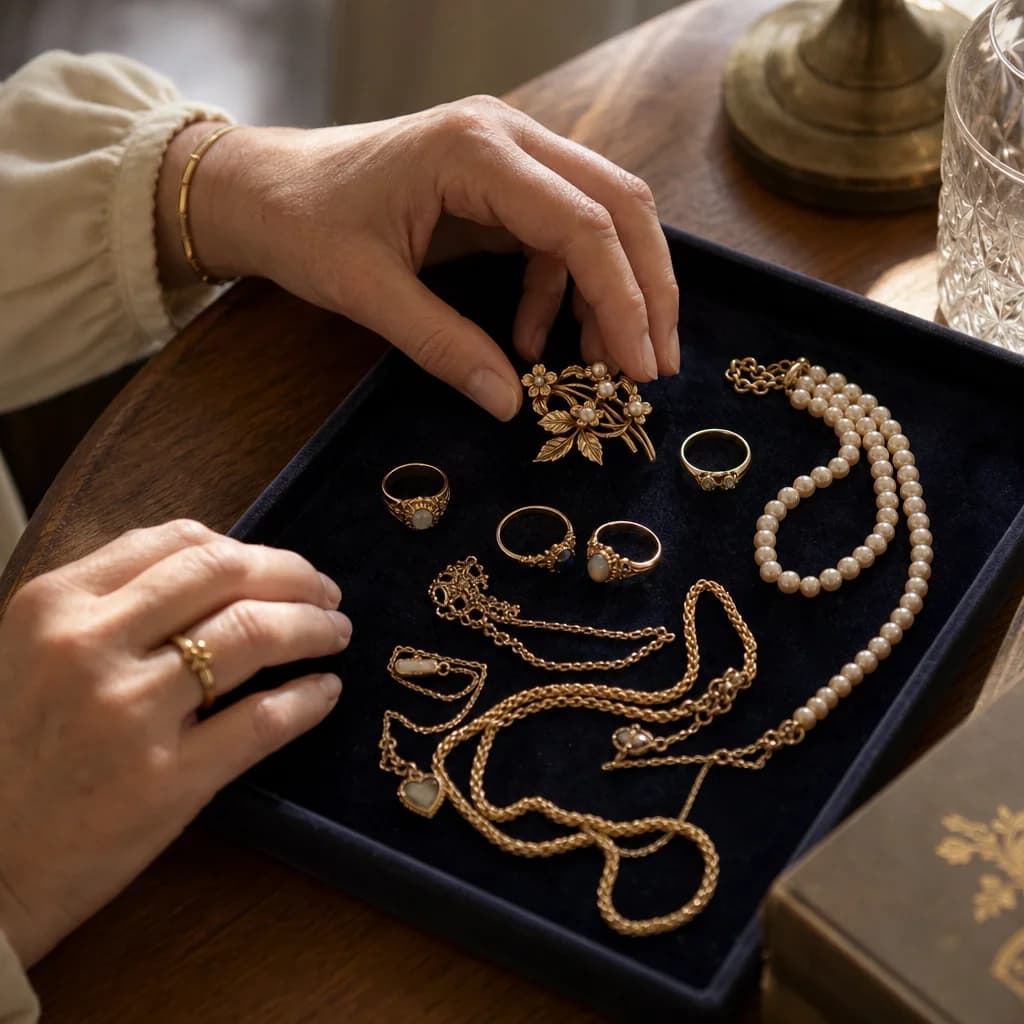
Do you need a formal appraisal?
Not always — it depends on why you're asking. A USPAP appraisal is a formal written report, prepared by a credentialed appraiser for a fee, typically needed for insurance coverage, estate filings, or dividing property fairly among heirs. It documents replacement value in detail and holds up as a professional record if one is ever needed.
A free evaluation for potential sale is a different, more informal conversation — its purpose is simply to help you understand what a piece would likely bring if you chose to sell it, with no fee and no paperwork requirement.
In New Jersey, probate or an equitable distribution of an estate among heirs sometimes calls for the formal appraisal route rather than an informal one. This is general information, not legal advice — the estate's attorney is the right person to confirm what your specific situation requires.
What an evaluation with us looks like
If you decide you'd like a professional look at what you've inherited, the evaluation itself is carried out by Heritage Gold & Silver, our licensed buying desk. The process is unhurried and itemized, piece by piece:
- Each item is looked at individually and explained to you in plain terms — what it is, and what shapes its value.
- You receive a written, itemized offer for anything you might consider selling, so nothing is verbal or vague.
- There is no pressure to decide on the spot. Take the offer away, discuss it with family, and come back whenever you're ready — or not at all.
- Discretion is respected throughout — this stays a private conversation, not a public listing.
If a watch came with the collection
Watches are judged on a different set of details than jewelry — the reference number, the condition of the case, whether the box and papers survived. If there is a Rolex, Omega, or Cartier among what you inherited, our companion guide explains what drives its value and how to have it identified from two photographs: Used Rolex prices in NJ: what is your watch worth?
Common questions
Is my jewelry worth more than the gold weight?
Often, yes. Gold weight is only the starting point — a maker's mark, a well-matched diamond line, or a recognizable period style can add considerably more than the metal alone. The only way to know is to have the full piece looked at, not just weighed.
Do I have to sell everything at once?
No. Many families sort an inherited collection piece by piece and decide separately what to keep, what to pass along within the family, and what to sell. There is no requirement to make one decision for the whole collection at the same time.
What if pieces are broken or missing stones?
That is common with inherited jewelry, and it is still worth having evaluated. A missing stone or a broken clasp does not erase the value in the metal, the remaining stones, or the maker. Let an evaluator see it before deciding whether repair makes sense.
Is there any obligation after an evaluation?
No. An evaluation is simply information. You are free to take the details away, think it over, discuss it with family, and decide later — or never — whether selling is the right choice.
How is this different from an insurance appraisal?
An insurance appraisal states replacement cost — what it would take to buy an equivalent new piece at retail today — and is typically prepared for a fee by a credentialed appraiser for insurance, estate, or legal purposes. A free evaluation for potential sale instead estimates what the piece would realistically bring on the secondary market. The two numbers are usually quite different, and neither one is wrong — they answer different questions.
Who actually makes an offer if I decide to sell?
Evaluations and any purchase are handled by Heritage Gold & Silver, our licensed buying desk. Heritage Trading Co's role on this page is simply to walk you through the information so you can make a decision at your own pace.