Most people researching what their Rolex is worth start the same way: a search, then a page listing models against figures, then a form that returns a number in seconds. It feels like an answer. In practice it is an average, calculated before anyone has looked at the watch.
A price list has to describe a category — "a Submariner," "a Datejust" — while the market pays for a particular example. Between those two things sit the reference variant, the state of the case, whether the dial and bezel are original, whether the box and papers survived, and how that reference happens to be trading this quarter. Any one of those can move the real figure well away from the published one, in either direction.
This guide explains what genuinely drives value, and how to get an estimate that reflects your watch rather than its model name. Nothing here asks you to sell.
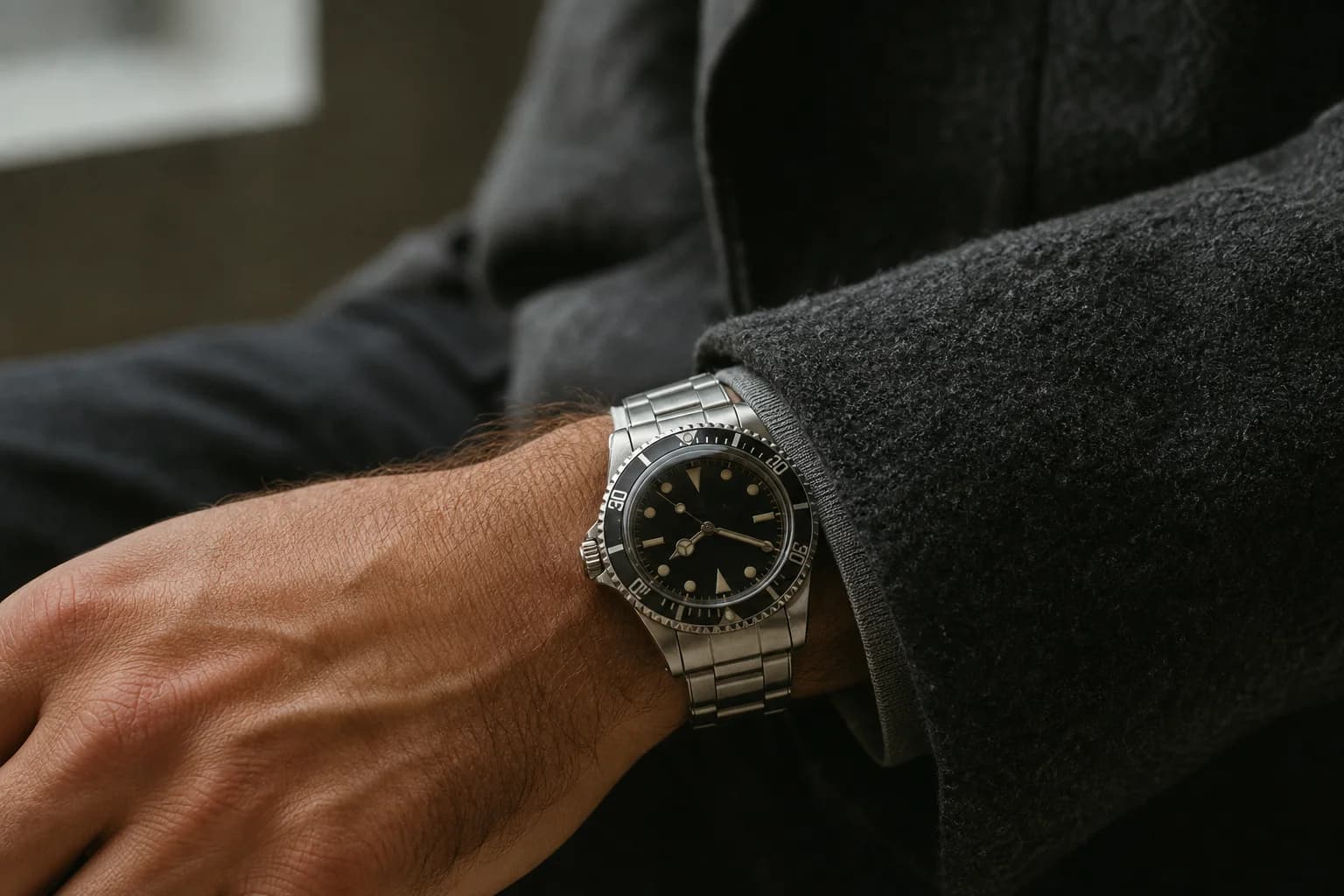
Path one
Get a real estimate
Tell us what you have. What you send goes to a person at our desk, who reads it and replies to you personally. No price is calculated, shown, or emailed automatically — because an honest one cannot be produced from a form.
Path two
Don't know what it is?
That's what we're for
Plenty of people come to us with a watch they inherited and cannot name. That is a normal place to start, not a lesser one. You do not need the model, the reference, or any paperwork. Bring us a photo, or bring us the watch.

Send us two photos
One of the dial — the face of the watch. One of the caseback — the flat side that rests against the wrist. Daylight, held steady, close enough to read any writing. That is usually all we need to tell you what it is.
Email info@heritagetrading.co or text +1 (845) 459-0385. We will tell you what the watch is whether or not you ever decide to sell it.
Or book a private appointmentBefore we meet. We photograph the serial and reference numbers when the watch comes in, and we check those details against stolen-property records ahead of the appointment. It costs you nothing and protects you as much as it protects us — which matters most with a watch that arrived through a family estate and no paperwork.
If the watch came to you along with rings, chains, or loose stones, our companion guide covers the rest of what families find: What is my inherited jewelry worth in NJ?
What actually drives value
None of this requires expertise to follow. It is simply what a specialist is weighing when they hold a watch and think about what it is worth.
The reference itself
Two watches can look almost identical across the room and sit in completely different places in the market. A reference that trades quickly and has steady demand behind it is worth more than one that sits, simply because a buyer is easier to find. Liquidity is part of value, not separate from it.
Box and papers
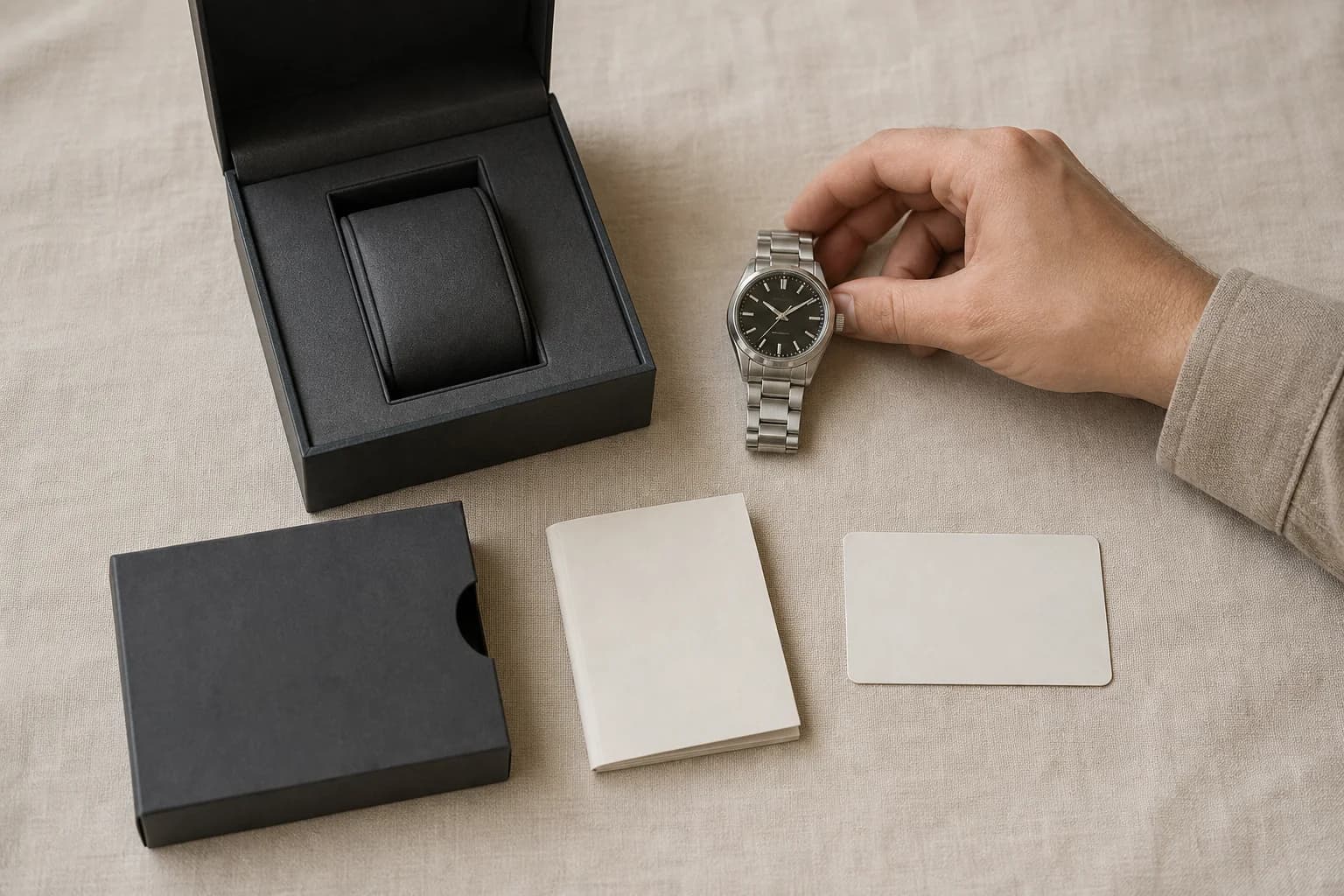
An original box, warranty card, and booklets matter more than most people expect. Where a full set is the norm for a reference, a watch missing its papers commonly gives up somewhere in the range of 5–15% against an otherwise identical example. On older pieces where sets rarely survived, the gap narrows considerably.
Condition and service history
Sharp, unpolished cases with crisp lugs read differently to a specialist than a case that has been repeatedly refinished. Service records help, but so does a watch that simply runs well. A piece that has sat unworn in a drawer for fifteen years is not automatically a problem — it just needs looking at.
Original parts versus replacements
Aftermarket bezels, dials, hands, or a diamond-set bezel added later almost always reduce value against an all-original example, even when the work is well done. Original parts that were swapped during a service also matter. This is one of the most common reasons a real number differs from an online estimate.
Current market conditions
The secondary market moves. A recently discontinued reference can trade at a premium for a stretch while supply is thin, then settle. Metal prices, interest rates, and broader collector appetite all feed into what a dealer can responsibly pay this month rather than last year.
What is actually in front of us
Everything above is general. The specific watch on the bench — its serial range, its bracelet stretch, its dial variant, its history — is what a number is finally built on. That is the part no published table can do.
Reference snapshot
Market conditions as of August 2026
Reviewed quarterly · next review November 2026
Brief commentary on three references we see most often. These are observations about how the market is behaving — not offers, and not valuations of any particular watch.
Datejust
The most widely held Rolex in family collections, and the one we see most often from estates. Demand is broad and steady rather than speculative, which makes it one of the more predictable references to place. Within the model, dial variant, bezel type, and bracelet make a real difference — two Datejusts of the same age can sit some distance apart.
Submariner
Consistently one of the most liquid watches in the market, which is precisely why generic figures for "a Submariner" are so unhelpful. Date versus no-date, ceramic versus aluminium bezel, and whether the case has been heavily polished all separate examples that a headline number treats as the same watch.
GMT-Master II
Interest in the model remains strong, with bezel color combinations driving much of the spread between individual examples. References that have been discontinued relatively recently have been trading at a premium while supply is limited — that is a condition of the moment, not a permanent state, which is exactly why we date this section.
Market commentary ages. If you are reading this well past November 2026, treat it as background and ask us where things stand now.
What happens after you reach out
There is no queue, no call center, and no automated follow-up sequence. It goes like this.
A private conversation
You send what you know, and a person from our desk replies — usually within one business day. Nothing is automated, and nothing is added to a mailing list you did not ask for.
An evaluation in person
We look at the watch itself, either by appointment in Northern New Jersey or, where it suits you better, on a house call. Estate collections are often easier to review where they already are.
Authentication before any number
The watch is authenticated and inspected first — movement, case, dial, bracelet, and parts. We do not discuss a figure before we know exactly what we are looking at.
A number, and no obligation
Any offer to purchase is made by Heritage Gold & Silver, our licensed buying desk. You are free to take it away, think about it, get another opinion, or decline. That is a normal outcome and we treat it as one.
Common questions
Are online instant quotes accurate?
They are estimates generated from a model name and a few dropdowns, before anyone has seen the watch. They can be a reasonable starting point for a common reference in ordinary condition. They cannot account for a replaced dial, a heavily polished case, an unusual variant, or a missing set — all of which move the real number. A figure quoted before authentication is, by definition, provisional.
Does it matter if I don’t have the box or papers?
It matters, but less than people fear. On modern references where full sets are common, missing papers typically costs somewhere in the 5–15% range against an identical complete example. On older watches, sets rarely survived at all, so their absence is expected and the effect is much smaller. A watch without its box is still very much worth evaluating.
What if I don’t know the model or reference number?
That is completely normal, especially with a watch you inherited. You do not need to identify it before contacting us — that is our job. Send a clear photo of the dial and one of the caseback and we will tell you what it is, in plain terms, at no cost and with nothing expected in return.
Is there any obligation after I submit the form?
None. The form starts a conversation, nothing more. There is no fee, no agreement, and no expectation that you sell. Many people write to us simply to find out what they have, and that is a perfectly good reason to get in touch.
How is this different from a mail-in watch buyer?
With a mail-in service you ship the watch away and wait for a figure from someone you never speak to. Here, the watch stays with you until you have decided. We evaluate it in front of you — by appointment or at your home — and explain what we are seeing as we go. If you decide against selling, the watch never left your hands.
Who actually buys the watch if I go ahead?
Purchases are made by Heritage Gold & Silver, our licensed buying desk. Heritage Trading Co. is the desk you are reading here — we handle the evaluation, the explanation, and the conversation.
Keep reading
- Watches — what we hold, our certification policy, and the private home trial.
- What is my inherited jewelry worth in NJ? — the companion guide for rings, chains, and loose stones.
- Estate sales — how a full collection or estate is handled, including house calls.
- Selling FAQ — documentation, timing, authentication, and payment answered in full.